


Tamara Moskvina: “No one is sitting around waiting for Russian athletes to return. I see how skaters and coaches from other countries are working hard to reach our level – and some comparisons are justified now.”
Tamara Moskvina on Navigating Challenges in Skating and Preparing for a New Season
original source: RT dd. by Elena Vaitsekhovskaya
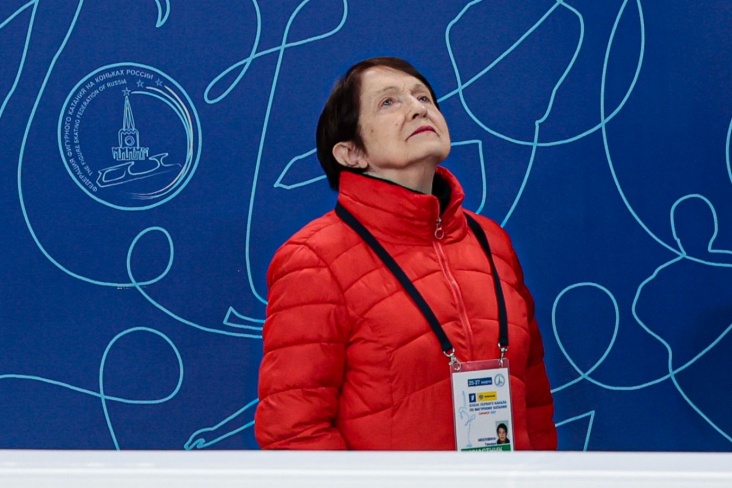
In an interview with RT, Tamara Moskvina shared insights into the challenges and motivations of preparing figure skating pairs in the absence of international competitions. Here’s a translation of her comments.
“Q: Have recent restrictions on Russian sports pairs from participating in the Milano-Cortina Olympics affected your work?
Tamara Moskvina: In principle, no. Our goal remains the same: to bring joy and entertainment to the audience, and to inspire admiration – or even criticism – from professionals. For this reason, we prepare programs the way we always have, without worrying about what language the audience speaks or where they’re watching from.
Q: Could there be a silver lining to Aleksandr Galliamov having more time to recover from his leg injury without rushing rehabilitation?
Tamara Moskvina: I think you’re trying to find a convenient explanation. When the injury happened, we analyzed the situation and realized that recovery would take time. Sash (Galliamov) injured his right leg, which bears a lot of stress during elements. With the missed Olympics in mind – or, more accurately, with our athletes being excluded from them – we immediately began planning for the next four-year cycle.
Q: If your skaters were allowed to compete in the Olympics, would you have had to force the process?
Tamara Moskvina: And so what if we had? Life rarely happens according to plan – unexpected situations arise in every field of work. The key is being able to make timely decisions, even if they’re not the ones you’d ideally want to make.
Q: I know you find ways to stay motivated, but young athletes don’t always think that way. Isn’t it a massive blow for skaters to miss the Olympics, especially when they know they have a chance at winning?
Tamara Moskvina: Yes.
Q: Who was more emotionally affected: Nastya or Sasha?
Tamara Moskvina: Of course, they were both upset, but we all accepted it as a fact of life. The ISU’s original communiqué clearly stated that the decision to grant neutral status would be made by a special committee using its own unexplained criteria. In other words, it was apparent from the start that there were no guarantees. I immediately told them, “Take a deep breath and wait for the results calmly.”
Initially, I had planned to start the season earlier so we’d be in good shape by September if the decision was in our favor. But then the injury happened, and once again, we had to adjust our plans.
Q: Has Galliamov completed his recovery?
Tamara Moskvina: Yes, his leg has healed. But he had to regain his athletic form, technical elements, and skating skills. We’ve worked through all of that and are now preparing for the season. At the test skates in St. Petersburg, Nastya (Mishina) and Sasha debuted their short program, and at the showcase event in Igora, they performed an exhibition number.
Q: Last season, your top pair skated at a very high level. What’s the goal for them now: to return to that level or to surpass it in some areas?
Tamara Moskvina: You’re a former athlete yourself – you know you can’t aim to simply stay at the same level. If you’re standing still, you’re already falling behind.
Q: That’s clear, but isn’t it different when health is a factor?
Tamara Moskvina: Then you need to think creatively and find ways to surpass yourself and your competitors.
For example, we’ve welcomed Albert Galichanin, a principal dancer with the Boris Eifman Ballet Theater, to our coaching team. He’s working with Mishina and Galliamov – and not only them – on the choreographic aspects of their programs. Put simply, everything the skaters do with their feet on the ice must match the music’s character, the program’s concept, and the highest standards of dance.
We’ve always worked like this. Whether it was with figures like Alexander Matveev, Yuri Potemkin, or David Avdysh, or even when Igor Moskvin worked with Yuri Ovchinnikov, bringing in Mikhail Baryshnikov – we’ve long combined technical and artistic expertise.
Q: A kind of “technical maintenance”?
Tamara Moskvina: I’d call it “artistic maintenance.” I don’t have the training to master every ballet or theater style, nor the expertise to perfectly adapt them to the ice.
Q: Was the decision to bring back your free skate from three years ago, with Elvis Presley hits, influenced by Galliamov’s injury?
Tamara Moskvina: It’s very challenging to design and stage a new free skate when someone has a broken leg and can’t train for five months. That’s why we reused the free skate. However, we did create a brand-new short program to music from the opera La Traviata.
Q: Did the idea to use an Italian theme come before or after the ISU’s verdict on Russian pairs?
Tamara Moskvina: Before. I wanted my skaters to leave a lasting impression on the Italian audience if they were allowed to compete, to elicit sympathy and emotional support.
Q: You’ve often employed this trick with your pairs, haven’t you?
Tamara Moskvina: It’s not a trick – it’s a strategy.
Q: And it works?
Tamara Moskvina: Absolutely. Judges are familiar with classics, especially globally renowned works like Giuseppe Verdi’s La Traviata. When the audience responds enthusiastically, it inevitably influences the judges. Unfortunately, the Olympics didn’t work out for us, but we decided not to change our program.
Q: Have you been following international competitions closely?
Tamara Moskvina: Practically, yes.
Q: How much progress have pairs competing internationally made in the past three years without Russian skaters?
Tamara Moskvina: I can say one thing: no one is sitting around waiting for Russian athletes to return. I see how skaters and coaches from other countries are working hard to reach our level – and some comparisons are justified now. Everyone is working seriously and actively.
Q: Does this narrowing gap seem threatening?
Tamara Moskvina: Of course. When our skaters eventually return to the international stage, they’ll compete as individuals, often skating in early warm-up groups. That impacts scoring. Some judges may not even remember our athletes, considering not everyone follows domestic competitions.
This is why I believe in planning for the worst-case scenario in advance – not engaging in overconfidence but instead anticipating all potential hurdles. Of course, you must also plan for success, but to achieve it, you must stay one step ahead – or better yet, two steps ahead – just in case someone tries to take one away.
Q: It seems that at every domestic competition, comparisons are constantly made between Mishina and Galliamov and their key rivals, Aleksandra Boikova and Dmitrii Kozlovskii.
Tamara Moskvina: That’s natural, as they’re the two strongest pairs in the country.
Q: Does it bother you if your pair starts losing in this rivalry?
Tamara Moskvina: Of course, it would be unpleasant, regardless of who they lose to. Considering Galliamov’s previous injury, I understand that it’s a possibility.
Q: The annual performances by your skaters in Igora – are these a nod to tradition or an essential part of training?
Tamara Moskvina: I would describe it as a longstanding social project. Guests of the resort, as well as people from nearby towns and even spectators from St. Petersburg and other cities, come to watch. They have the opportunity to see Russia’s top skaters perform live, free of charge.
For our athletes, it’s a great chance to perform programs in front of a wider audience, and for some, it’s their very first live audience.
Q: Does the sensation of performing for an audience fade quickly without competitions?
Tamara Moskvina: It’s not necessarily about fading, though skaters can become unaccustomed to it over time. What’s important is how differently they skate in front of an audience compared to in practice. Ask any actor or performer in show business – they’ll tell you the same thing. For some, the audience energizes them, while for others, nerves can be paralyzing.
We train skaters to ensure that the presence of an audience doesn’t negatively impact the quality of their performance. They learn to work with the crowd, use techniques to suppress anxiety, and elevate their emotional energy. Those who find competitions overly stressful are taught how to manage it. We also coach athletes who are overly emotional or overly reactive to spectator feedback, ensuring they stay in control and don’t lose focus.
Q: I once heard someone say of Yuzuru Hanyu that, as a star of his stature, it didn’t matter what was happening around him – he relied entirely on himself.
Tamara Moskvina: I disagree. Hanyu has always been deeply focused on his skating, music, and choreography, but his programs were crafted to impress the audience. I never got the impression that he skated “just for himself.” He skated knowing that every move he made was closely watched.
To help younger athletes develop skills like this, they need opportunities to perform for audiences as often as possible. And this is why Igora is so valuable – not just for training but for connecting athletes to the audience.
Another element of Igora that makes it special is that, after their performances, skaters spend 30 minutes on the ice with children from the audience in a free, informal masterclass. They demonstrate movements, take pictures, sign autographs, and chat with the kids’ parents, encouraging them to connect with figure skating.
Q: Do you also lace up your skates for Igora performances?
Tamara Moskvina: Of course. I host the event with a microphone, cracking jokes to keep things lively. I provide demonstrations, draw attention to particular details – for example, something as simple as how long to hold a final pose.
Q: What do you mean by holding a final pose?
Tamara Moskvina: For example, when a skater finishes their program, they bow and rush off the ice so quickly that the audience doesn’t have time to react. So I explain: when you strike the final pose, hold it for at least three counts – give the audience time to applaud. It’s such an elementary concept, yet even public speakers at presentations use the same technique.
At Igora, I sometimes have Yuko Kavaguti perform. Her former partner Alexander Smirnov is now a coach in our junior pairs program. I enjoy staging a little scene: I’ll say, “Do you remember the pair Kavaguti and Smirnov?” And then, they’ll step onto the ice together and perform a lift across the rink. For the audience that remembers them, it’s a treat – a chance to reminisce and feel nostalgic.
Q: Your junior pairs represent the next generation of elite skating. Should they already be mastering quad elements, such as throws and twists?
Tamara Moskvina: It’s too early to discuss this. Junior pairs sometimes skate together for only one or two seasons. Attempting quad elements without proper experience and technical preparation is far too dangerous in pair skating.
Q: Why does progress in pair skating seem slower than in singles?
Tamara Moskvina: There’s a natural limit to what athletes can achieve in terms of executing complex jumps. Pair skating also requires synchronized execution and precise coordination at close distances – these are not simple tasks. Success requires extensive training.
Additionally, pair elements come with significantly higher risks. This applies to twists, throws, and lifts, where any technical misstep can lead to serious issues – even injuries. I firmly believe no difficult element is worth risking an athlete’s health. Even a minor slip during a lift dismount can result in serious problems if something goes wrong.
Q: Is this why pair skating is considered the most difficult discipline?
Tamara Moskvina: I wouldn’t want to sound biased, as singles and ice dance have their own complexities, but skating in pairs is undeniably more fun than skating alone. That said, there’s a built-in challenge: you always have someone to argue with! In singles, you’re mostly alone with your coach. But as two-time Olympic champion Artur Dmitriev says, “Who has it easy nowadays? Even the rink employee cleaning the floor every day on his machine has his own challenges.”
Q: What I love about you is your enduring sense of humor.
Tamara Moskvina: Well, what can I say? Life is arranged this way – with challenges, advantages, and moments of enjoyment in both life and work. You have to strive not just for professional achievements or to avoid failures but to create a multifaceted life filled with positive energy and meaningful experiences. That is my motto.”
Related topics: Tamara Moskvina
Leave a Reply