


Alexei Urmanov: “Last season, we focused on doing what we could reliably execute. Every season is tougher than the last. After Worlds in Boston, Shaidorov said he would try to add more difficulty to his programs.”
Interview with Alexei Urmanov.
original source: RSport dd. April 30th 2025 by Boris Khodarovsky
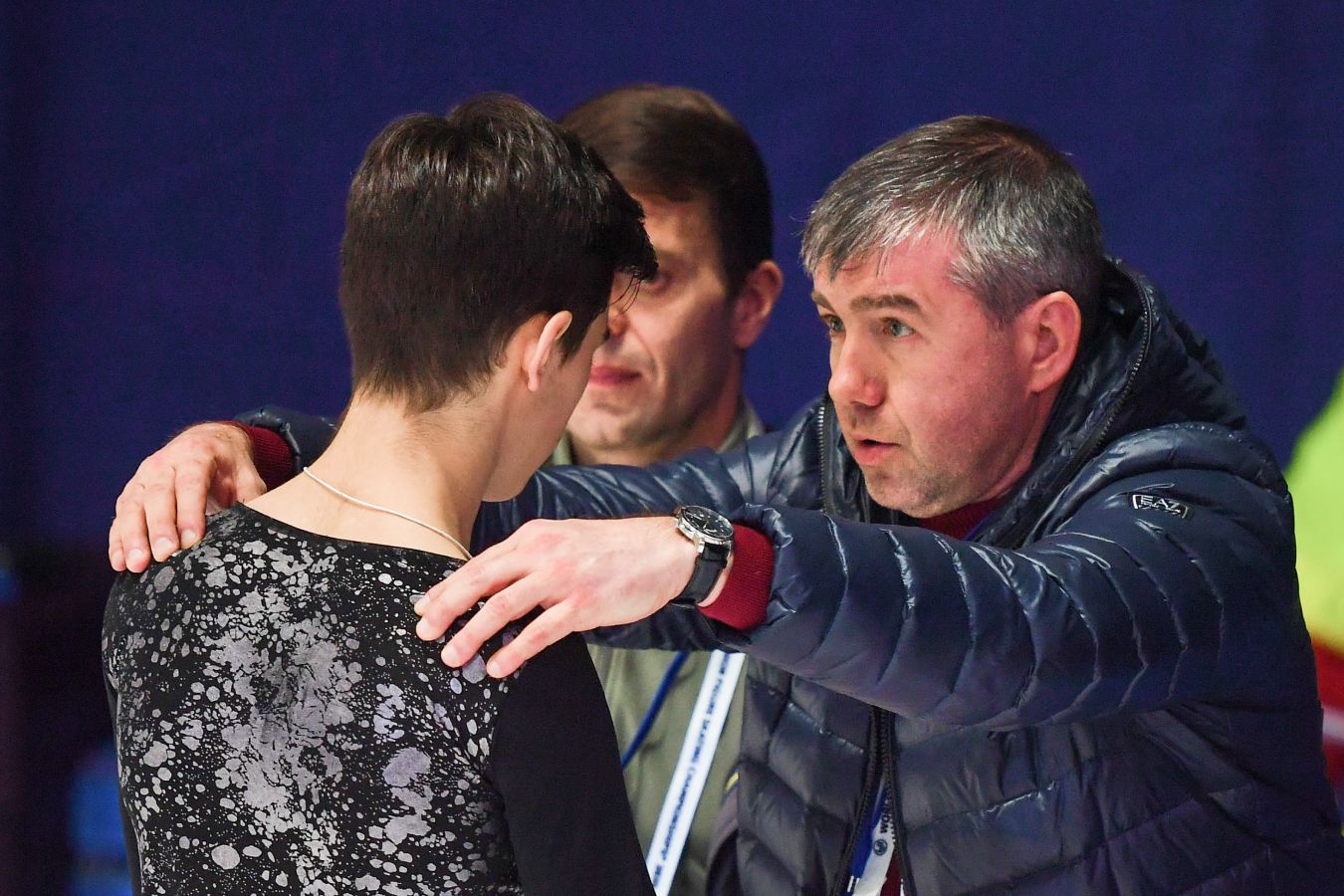
In an interview with RSport, coach Alexei Urmanov discusses the success of his student Mikhail Shaidorov and opened up about the challenges of working with Julia Lipnitskaya. Here’s a translation.
“Q: Last year, Shaidorov finished 14th at the World Championships and sixth at the Four Continents Championships. This year, he’s a silver medalist at Worlds and champion at Four Continents. How do you explain such rapid progress?
Alexei Urmanov: I’ve been working with Mikhail for seven years. We started collaborating at a training camp in Yoshkar-Ola, where his father and coach brought him. In 2018, Shaidorov asked to train with me in Sochi, telling his parents, “Give me a chance!” He quickly grasped new concepts, but we didn’t rush his development. Mikhail always lagged behind his peers, which wasn’t his fault — he had been training on outdoor rinks in Almaty. When I first saw him in Yoshkar-Ola, I was surprised to see him skating in a beanie, even though the ice rink had comfortable indoor temperatures. That habit stuck with him.
Q: Have you been awarded the title of Honored Coach of Kazakhstan?
Alexei Urmanov: That honor went to Stanislav Shaidorov, and it’s well-deserved because he laid Mikhail’s technical foundation. I’m not eligible for the title, as it’s only given to residents of Kazakhstan.
Q: Is having a father as a coach a help or a hindrance when working with Shaidorov?
Alexei Urmanov: Currently, Stanislav Shaidorov coaches in Sochi on the same rink as me. He has his own group, and I have mine. We see each other every day. I’m very grateful that Stanislav entrusted his son to me and doesn’t interfere with the training process. We have excellent relationships off the ice.
Q: However, Mikhail’s father sometimes accompanies him to competitions.
Alexei Urmanov: That happens if I can’t travel with Mikhail. In such cases, there’s no better person to be by the boards or in the kiss-and-cry area.
Q: Does this difficulty stem from holding a Russian passport?
Alexei Urmanov: Two years ago, during mobilization, I wasn’t allowed out of Russia as a reserve officer when I tried to cross the Finnish border. I had planned to travel to the Finlandia Trophy in Espoo via the usual route from Saint Petersburg. I had a valid visa, but this unexpected obstacle came up. I had to make a late-night call to Stanislav Shaidorov and have him travel from Sochi to Saint Petersburg to accompany Mikhail.
Q: Shaidorov’s arsenal includes unique combinations of triple axels and quad jumps. Whose idea was this innovation?
Alexei Urmanov: First of all, I want to note that Shaidorov is an incredibly talented figure skater. These ultra-difficult elements wouldn’t be possible for many others. What’s equally important is that Mikhail is an athlete who always takes the initiative. Some skaters simply follow the coach’s instructions and lack creativity, but Shaidorov always wants to experiment with something unusual. This is a great advantage for both the skater and the coach.
Q: In his free skate, Shaidorov performs four quads. Is that enough to compete at a serious level?
Alexei Urmanov: Last season, we focused on doing what we could reliably execute. As Tatiana Tarasova — beloved and respected by all — once said, you do what you’re capable of. Every season is tougher than the last. I have many ideas in mind, and we will definitely discuss them with Mikhail. After the World Championships in Boston, he said he would try to add more difficulty to his programs.
Q: Is coaching in Kazakhstan under tight oversight from the federation and Ministry of Sport?
Alexei Urmanov: You can’t compare Kazakhstan to Russia. They don’t have test skates there, but the federation and those involved with Shaidorov and me are always aware of our work. We send training videos as part of our routine.
Q: There have been rumors that Kazakhstan is interested in naturalizing Russian figure skaters, with rumored names including Egor Rukhin and Roman Savosin.
Alexei Urmanov: I’m not interested in this issue and don’t have any details. The plans of the Kazakhstan federation are theirs alone. I think I have a good working relationship with them. I am Mikhail Shaidorov’s head coach, instructor, and mentor. I do not participate in other initiatives related to developing figure skating in Kazakhstan.
Q: Shaidorov mentioned in an interview that if someone had told him at the start of the season about his eventual success at major competitions, he wouldn’t have believed it. When did you start to feel confident he could compete with top skaters from the U.S. and Japan, backed by strong federations?
Alexei Urmanov: We had a solid preparation period and built a strong program, but during Shaidorov’s first Grand Prix event in France, the judges’ evaluations gave no reason to expect a breakthrough. What prospects for the top ranks could there be? Nevertheless, justice prevailed – Mikhail entered the Grand Prix Final as the first alternate after Adam Siao Him Fa’s injury. That’s when his climb began.
Q: In the early 90s, you were the first skater to consistently perform quads in competition. Could you have imagined that 30 years later, skaters would be doing seven quads in a free skate?
Alexei Urmanov: I didn’t think about it back then. An old-fashioned coachman from centuries ago could never have imagined modern cars. The progress we’re seeing in terms of technical difficulty is remarkable. Isn’t it amazing?
Q: Is Ilia Malinin, who landed seven quads, a “monster”?
Alexei Urmanov: Absolutely, in the best sense of the word. He’s an incredibly talented skater with excellent training.
Q: Last season, many skaters chose music from Dune for their programs, including Mikhail Shaidorov, Adam Siao Him Fa, Petr Gumennik, EvgenyiSemenenko, Niina Petrokina, and the Spanish ice dance duo Olivia Smart/Tim Dieck. How did you decide on it?
Alexei Urmanov: The idea came from Mikhail himself. He loved the film and was inspired to skate to Hans Zimmer’s music. We weren’t afraid that others might choose the same soundtrack. After all, in past seasons, haven’t we seen countless Carmen, Pirates of the Caribbean, or Notre Dame de Paris programs? Repetition doesn’t matter as long as the choreography isn’t plagiarized. Even within Dune, everyone used different music segments. Shaidorov and Fa, for example, had entirely distinct excerpts.
Q: Could Shaidorov draw inspiration for character development from the Spanish ice dance team’s brilliant work?
Alexei Urmanov: Possibly. Every skater has role models to learn from. Shaidorov openly admires Yuzuru Hanyu, and naturally, he’s picked up some things from him, though it’s hard to say exactly what.
Q: Do you follow developments in Russian figure skating?
Alexei Urmanov: Of course, I do, although I’m not deeply immersed in it. Currently, there are no Krasnodar Region skaters competing successfully at Grand Prix events or qualifying for the Russian Nationals. The regional federation and sports ministry emphasize that those representing the region must train locally. The strongest skaters are either already training in Moscow or Saint Petersburg or are aiming to relocate there.
Q: Has Sofia Muraviova ever asked to join your group, even for a trial?
Alexei Urmanov: No, no one really asks to join us. Sochi doesn’t offer the best conditions for training, despite the Olympic legacy. Few people believe that, but unfortunately, it’s true.
Q: At one point, you tried to revive Julia Lipnitskaya’s career. Do you follow her life now?
Alexei Urmanov: I’m very happy for Julia. She’s doing well — she has two children and a job she enjoys. There’s no point in revisiting what happened years ago; that story is behind us. We worked wonderfully with Julia, and I have only the fondest memories.
When Lipnitskaya first came to Sochi, she looked like a scared little animal. It took three to four months for her to transform into a normal, happy child, which is how she was for me throughout our time working together. She thawed out while training in Sochi. I’m proud that I was able to “defrost” an Olympic champion. And with that, let’s close this chapter.
Q: Professor Mishin once said that Urmanov is a skater perfectly suited for portraying royal characters on ice. Would you consider performing in a show with Alina Zagitova, for example?
Alexei Urmanov: No, that doesn’t interest me anymore. My time in figure skating as a performer, even in shows, is over. Now it’s the time for my students.
Q: You were one of the first to try organizing an ice show in Russia, but the experience was unsuccessful, and you had to sell an apartment in Saint Petersburg to pay the participants.
Alexei Urmanov: That only proves that I’m a terrible businessman. Everyone should stick to their profession: teachers should teach, doctors should heal, and coaches should train. After that first attempt at organizing a show, I realized it wasn’t for me — and I made the right decision!
Of course, the idea of holding ice shows in Russia was obvious. All the leading Russian skaters participated in similar shows in North America. But to transform the concept into something spectacular, you need to be an Ilia Averbukh to execute it so brilliantly.
Today, Tatiana Navka and Evgeni Plushenko have their own projects, and other stars who have recently retired are trying to get involved. That’s wonderful. We have so many outstanding figure skaters who, for a time, weren’t utilized to their full potential!”
Related topics: Alexei Urmanov, Mikhail Shaidorov
Leave a Reply