


Haein Lee: “Honestly, after last season ended, I didn’t have a clear motivation. At the end of every season, I’d say I wanted to jump the triple axel next season. This time, I really wanted to make it happen.”
South Korean figure skater Haein Lee finished sixth in the women’s short program at the Cup of China with 67.49 points, successfully landing her triple axel while reflecting on her new program, costume symbolism, and motivation.
original source: mfocus.kr dd. 6th November 2026 by Park Jimin
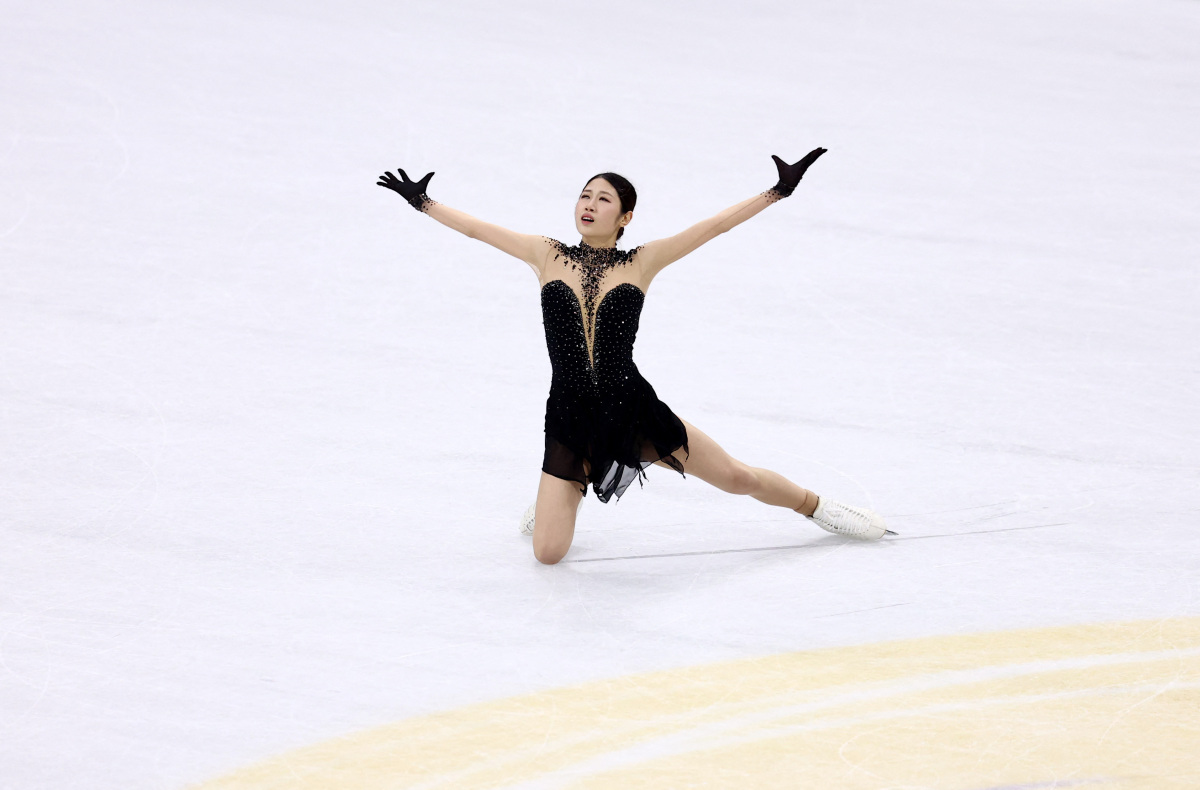
On Friday, November 6, the women’s singles short program of the 2026 ISU Grand Prix Series Cup of China took place at the Shenzhen Universiade Sports Center in Shenzhen, China. South Korean national representative Haein Lee performed to Experience, scoring 34.86 points in technical elements (TES) and 32.63 points in program components (PCS) for a total of 67.49 points, placing 6th among the 12 competing skaters. Here’s a translation of her comments posted on MFocus.
Lee received an under-rotation call (q) on her opening jumping element, the triple axel, but successfully landed it.
Speaking to reporters in the mixed zone right after the competition, Lee expressed mild disappointment over the opening jump error while voicing happiness about landing the triple axel. However, an error occurred on her planned triple lutz-triple toe loop combination, where the triple lutz was reduced to a single lutz.
“I was really surprised when the triple lutz was executed as a single rotation,” Lee said. “Still, I was happy that I could land the triple axel. I wasn’t overly nervous this time. Rather, I felt confident and just wanted to do my absolute best. Because of a major mistake in the program, I didn’t have huge expectations for today’s score. Even so, I believed I could get a better score than last year.”
When asked about her thoughts on other skaters performing the triple axel, Lee noted that she looks for lessons from athletes who excel beyond her level.
“There are so many really good skaters. Because every skater excels in their own way, I think I feel a mix of emotions,” Lee explained. “Thinking about the skaters who jump the triple axel, they are better than me and I have things to learn from them.”
When asked what motivated her to push more aggressively for the triple axel this season, Lee candidly admitted that she had struggled to find clear motivation after the conclusion of last season.
“Honestly, after last season ended, I didn’t have a clear motivation. Of course, there were many people who inspired and helped me, and I am always grateful to everyone who supports and helps me. But I didn’t have a clear motivation of my own. At the end of every season, I’d say I wanted to jump the triple axel next season. Then when next season came, I’d say I definitely had to jump it next season, and repeated the same thing the season after. This time, I really wanted to make it happen.”
Lee explained that focusing so intensely on the triple axel during this competition caused her to momentarily lose grip on other elements. In practice, getting absorbed in mastering the axel sometimes led to neglecting other jumps and components.
“As I kept practicing the triple axel, I felt like I kept forgetting other elements. When you get completely absorbed in the triple axel, you miss other elements at times. I don’t think today’s mistake is something I can forgive myself for. Still, I’m glad I didn’t make a mistake where I couldn’t attempt a combination jump at all. In the free skating, I want to perform with the same confidence I had today. I’m trying not to dwell on today’s single mistake by constantly second-guessing myself. I want to skate while maintaining this exact confidence.”
Having previously visited Shanghai, Beijing, and Chongqing, she noted that her first visit to Shenzhen left a great impression regarding both the venue and the audience.
“Both the venue and the audience were really warm,” she shared. “The energy sent by the audience is truly wonderful. Thanks to that, rather than feeling like I was competing, I felt like I was an actor in a musical. I was so happy that they cheered for me today. I really love competitions held in China. The fans are amazing, and I am always grateful for the cheers they send.”
The short program Experience captures the difficulties Lee has experienced as an athlete and her determination to overcome them.
“There are moments as a skating athlete where things don’t go well. Of course, many people help me, but ultimately I am in a position where I have to do it alone. The story captures the moments of enduring those hard times and realizing things as you succeed in each jump. It’s closer to the meaning ‘I have to do it’ rather than ‘I can do it.’ Since everyone is helping me, I felt I needed to become stronger – I think that was the story.”
The narrative of the program is reflected not only in the choreography but also in the costume. Having contributed directly to the costume design, Lee explained that she wanted to visually express the time and emotions she has endured through her gloves and shoulder details.
“I came up with the ideas for the gloves and shoulder parts. I wanted to express the feeling of my sweat, tears, and blood soaking into this costume starting from my fingers. At the end – not in the sense of dying, but it ends with the feeling of me sinking into it. If you look closely, the beads are also in the shape of a cross. It’s expressed as if there is a neck going upward. It also contains the meaning of skating with gratitude for being alive.”
Related topics: Cup of China, grand prix, Haein Lee
Leave a Reply